

When heavy rainfall and landslides struck several parts of Nepal in late September, the impact was devastating for many families living in already fragile conditions. Among them was Kamala Phuyal, a 40-year-old blind woman living in Budhanilkantha Municipality, Ward No. 13, with her husband, who has a physical disability, and their young daughter. The family lived in a small shelter made of zinc sheets, barely adequate even before the disaster. Continuous rain damaged the structure further, destroying their external toilet and weakening the house itself, which stood in an increasingly unstable area. With limited income and compounded vulnerabilities related to disability and poverty, the family had no means to repair the damage on their own.
As part of its emergency and contingent response, NDWA began coordinating with project municipalities and partner networks to identify persons with disabilities affected by the disaster. During this process, Kamala’s situation was identified as requiring urgent attention. A field visit was conducted by the Project Coordinator and Community Campaigner to assess the risks and immediate needs faced by the family. Recognizing the seriousness of the situation, NDWA initiated coordination with Budhanilkantha Municipality, engaging the Women and Children Division, Population and Social Division, and municipal leadership to explore possible support options.
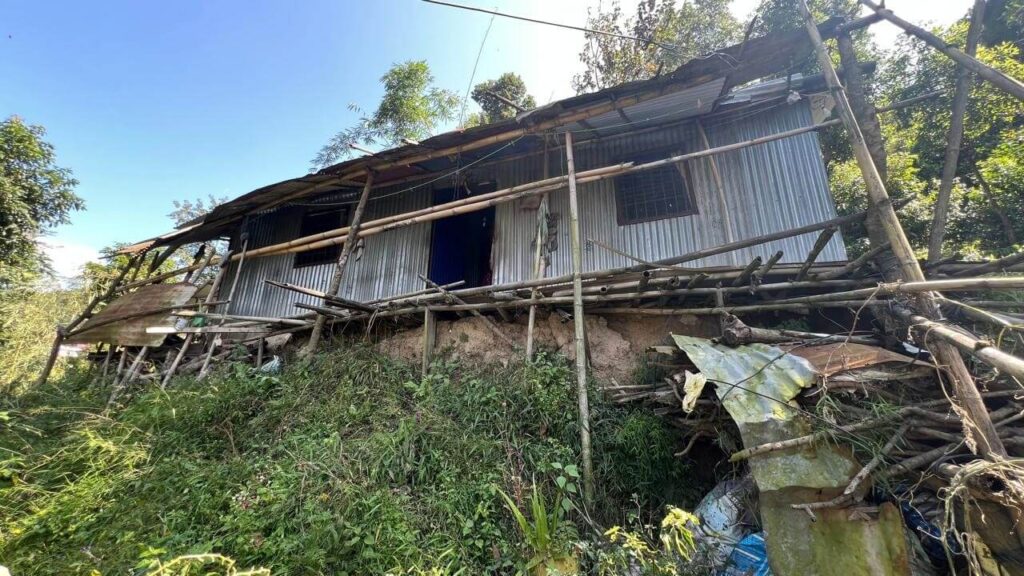
Through a series of follow-up meetings with municipal officials, including the Deputy Mayor and technical teams, a collaborative plan was developed. The municipality committed to providing technical support—preparing cost estimates, assigning engineers, and supervising construction—while NDWA agreed to extend financial assistance to enable the work. Despite further damage caused by additional rainfall in October 2025, coordination efforts continued. Kamala herself submitted a formal application to the municipality, and quotations were obtained to finalize the construction process. NDWA completed the procurement process and supported the initiation of construction work.
While full reconstruction of the house was not possible due to financial constraints, the completed work significantly strengthened the structure, improving safety and basic functionality for the household. For Kamala and her family, this support reduced daily risks and restored a sense of security and dignity after months of uncertainty. The intervention ensured that disability-specific needs were taken into account and that a family at risk was not left behind in the aftermath of disaster.
This experience underscored the importance of inclusive emergency response mechanisms that actively identify and prioritize persons with disabilities. It also demonstrated the value of strong collaboration between local governments and organizations of persons with disabilities. Even modest, well-coordinated support can bring meaningful change, particularly when technical expertise and community-based advocacy work hand in hand. Kamala’s story stands as a reminder that inclusive disaster response is not only about rebuilding structures, but also about restoring safety, dignity, and hope.